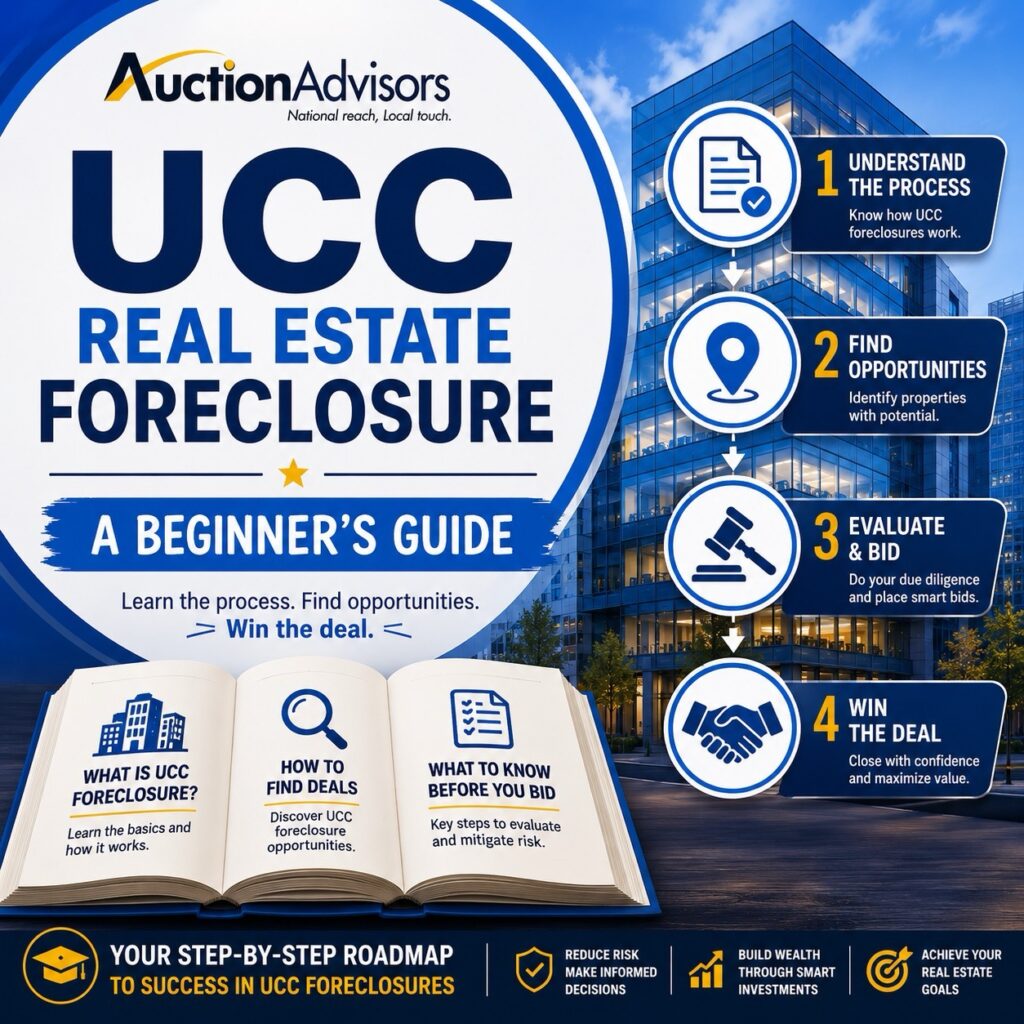
The commercial real estate market presents investors with many opportunities to purchase valuable assets below market value. Among these opportunities, UCC real estate foreclosures have become increasingly common, especially in complex commercial transactions involving limited liability companies (LLCs). While these sales often attract experienced investors because of their speed and flexibility, they also require a deeper understanding than a traditional foreclosure.
Many first-time buyers mistakenly assume that purchasing through a UCC foreclosure is the same as buying a foreclosed property from a bank or courthouse auction. In reality, the transaction follows a completely different legal framework. Instead of purchasing the real estate itself, buyers often acquire ownership interests in the legal entity that owns the property. This distinction affects everything from due diligence to liability and long-term investment strategy.
Understanding how these transactions work before placing a bid can help investors avoid costly surprises while identifying opportunities that others may overlook.
Whether you are an investor exploring distressed assets, a lender evaluating recovery options, or simply looking to expand your knowledge of commercial real estate, learning the fundamentals of UCC foreclosures is an important first step.
Understanding How a UCC Real Estate Foreclosure Works
What Is a UCC Foreclosure?
A UCC foreclosure refers to a sale conducted under Article 9 of the Uniform Commercial Code (UCC). Unlike a traditional judicial foreclosure, where ownership of real estate transfers through court proceedings, a UCC foreclosure focuses on personal property used as collateral.
In many commercial real estate transactions, the borrower does not personally own the property. Instead, the property is owned by a limited liability company (LLC). The lender secures the loan by taking a pledge of the LLC’s membership interests rather than placing the real estate itself into foreclosure. If the borrower defaults, the lender may foreclose on those ownership interests through a UCC sale.
This process allows the lender to transfer ownership of the company without initiating a lengthy judicial foreclosure proceeding.
Because of this structure, buyers are investing in a business entity rather than simply purchasing a piece of real estate.
Why Commercial Properties Frequently Use This Structure
Commercial real estate transactions often involve sophisticated ownership structures designed to improve financing, asset protection, tax planning, and operational management.
Instead of purchasing a commercial building individually, investors frequently establish an LLC that becomes the legal owner of the property. The LLC then enters financing agreements with lenders.
If financial difficulties arise, the lender’s collateral may consist of the ownership interests in that LLC.
This approach offers several practical advantages:
- Faster enforcement after default
- Reduced legal expenses
- Greater flexibility during asset disposition
- Fewer court-related delays
For lenders, these benefits can significantly reduce the time required to recover collateral compared to traditional foreclosure proceedings.
For buyers, however, the process introduces additional responsibilities because they are stepping into an existing legal entity with its own history, obligations, and contractual relationships.
Why More Investors Are Paying Attention to UCC Foreclosure Sales
Commercial real estate markets continue to evolve, creating new opportunities for investors willing to perform careful research.
Several factors have increased interest in UCC foreclosure sales:
- Rising commercial loan defaults
- Office market challenges
- Retail property restructuring
- Hospitality sector fluctuations
- Increasing institutional investment activity
Many investors recognize that these sales may offer competitive pricing compared to traditional acquisitions.
However, experienced buyers understand that a discounted purchase price alone should never drive an investment decision.
Every UCC foreclosure requires careful evaluation of:
- Existing financing
- Ownership structure
- Operating agreements
- Legal compliance
- Property performance
- Outstanding liabilities
Without proper investigation, an attractive opportunity can quickly become a complicated legal and financial challenge.
Investors interested in monitoring available opportunities can explore current listings through AuctionAdvisors’ dedicated UCC foreclosure sales
Understanding Article 9 of the Uniform Commercial Code
Article 9 governs secured transactions involving personal property.
When membership interests in an LLC serve as loan collateral, Article 9 establishes the legal framework that lenders must follow if the borrower defaults.
The lender cannot simply seize ownership.
Instead, Article 9 generally requires the lender to conduct a commercially reasonable sale, providing appropriate notice to required parties and following established legal procedures before transferring ownership interests.
These legal protections are designed to balance the interests of:
- Borrowers
- Secured lenders
- Other creditors
- Potential buyers
Because every transaction is unique, experienced legal counsel remains an essential part of any successful acquisition strategy.
Why Investors Should Understand the Process Before Bidding
One of the biggest mistakes first-time investors make is assuming every foreclosure operates the same way.
Traditional foreclosures primarily focus on transferring title to real estate.
A UCC foreclosure involves evaluating both:
- The underlying property
- The legal entity that owns it
This dual analysis requires buyers to think beyond the property’s location, condition, or rental income.
Instead, investors must evaluate the complete financial and legal picture surrounding the ownership entity.
That includes reviewing organizational documents, financial statements, debt obligations, litigation history, operating agreements, tax filings, and existing contractual commitments before making an investment decision.
Buyers who approach these transactions with a comprehensive due diligence strategy are often better positioned to identify opportunities while managing potential risks effectively.
How UCC Foreclosures Differ from Traditional Foreclosures
Understanding the distinction between a UCC foreclosure and a traditional real estate foreclosure is one of the most important steps for any investor. Although both processes occur after a borrower defaults on a loan, they follow different legal procedures and result in different types of ownership transfers.
For first-time investors, assuming these transactions work the same way can lead to costly misunderstandings. Knowing how each process functions will help you evaluate opportunities more effectively and prepare for the additional due diligence that UCC sales require.
The Biggest Difference: What Is Being Sold?
In a traditional foreclosure, the lender forecloses directly on the real estate. Once the foreclosure process is complete, ownership of the property transfers to the successful bidder or lender through a deed.
A UCC foreclosure works differently.
Instead of selling the real estate itself, the lender sells the ownership interests in the LLC or other business entity that owns the property. The LLC continues to hold legal title to the real estate before and after the sale the only change is who owns the company.
This distinction has significant implications because the buyer is acquiring an existing legal entity with its own assets, liabilities, contracts, and obligations.
Court Process vs. Private Sale
Traditional foreclosures often involve judicial oversight, depending on state law. The process typically includes:
- Filing a foreclosure lawsuit
- Court hearings
- Legal notices
- Redemption periods in some jurisdictions
- Public foreclosure auctions
These steps can take several months or even years to complete.
By contrast, many UCC foreclosures are conducted outside the courtroom under Article 9 of the Uniform Commercial Code. When the lender has a properly perfected security interest, it may conduct a commercially reasonable sale after satisfying applicable notice requirements.
Because there is less court involvement, UCC sales are often completed much faster than traditional foreclosures.
Ownership Responsibilities Are Very Different
In a traditional foreclosure purchase, the buyer generally receives ownership of the property itself, subject to applicable liens and legal priorities determined by the foreclosure process.
With a UCC foreclosure, the buyer assumes ownership of the business entity.
That means the LLC continues operating exactly as it existed before the sale.
Depending on the circumstances, the buyer may inherit:
- Existing contracts
- Vendor relationships
- Lease agreements
- Pending litigation
- Tax obligations
- Regulatory compliance issues
- Financial reporting requirements
Rather than starting with a “clean slate,” the buyer steps into the position previously held by the former ownership.
This is why experienced investors evaluate both the property and the entity before bidding.
Existing Liens May Continue After the Sale
Another major difference involves liens and debt.
In many traditional foreclosure situations, junior liens may be extinguished according to applicable state law and lien priority rules.
A UCC foreclosure generally does not eliminate liens attached to the real estate because the property itself is not being foreclosed upon. Instead, the ownership interests in the LLC are transferred, while the underlying mortgages, tax liens, and other encumbrances may remain in place.
As a result, buyers should carefully review:
- Mortgage balances
- Loan maturity dates
- Tax records
- Recorded liens
- UCC filings
- Existing creditor claims
Understanding the property’s complete capital structure is essential before making an investment decision.
Due Diligence Is More Comprehensive
Every real estate investment requires due diligence, but UCC foreclosures demand an additional layer of investigation.
Traditional property acquisitions typically focus on:
- Title searches
- Property inspections
- Surveys
- Environmental assessments
- Market analysis
A UCC foreclosure requires all of the above, plus extensive entity-level due diligence.
Buyers should also review:
- LLC operating agreements
- Membership records
- Financial statements
- Tax returns
- Corporate governance documents
- Pending lawsuits
- Existing contractual obligations
- Security agreements
Failing to investigate these areas can expose buyers to unexpected financial and legal risks after closing.
Why Many Lenders Prefer UCC Foreclosures
From a lender’s perspective, UCC foreclosures offer several practical advantages.
They are often:
- Faster than judicial foreclosures
- Less expensive to administer
- More flexible in timing
- Conducted without lengthy court proceedings
These benefits allow lenders to recover collateral more efficiently.
However, the streamlined process places greater responsibility on buyers to perform independent research before participating in the sale. Investors cannot rely on court supervision to identify every potential issue.
Experienced professionals understand that speed should never replace careful analysis.
Which Type of Foreclosure Is Better for Investors?
Neither option is inherently better they simply serve different investment strategies.
Traditional foreclosures may appeal to buyers seeking a more familiar acquisition process.
UCC foreclosures often attract sophisticated investors who understand entity acquisitions and are prepared to conduct comprehensive legal, financial, and operational due diligence.
When approached with the right expertise, UCC foreclosures can provide access to unique commercial real estate opportunities that may not be available through conventional channels. The key is recognizing that success depends on understanding both the property and the entity that owns it, not just the purchase price.
What Buyers Actually Acquire in a UCC Foreclosure
One of the most common misconceptions about UCC foreclosure sales is that the successful bidder receives ownership of the real estate. In reality, the buyer is purchasing something very different: the ownership interest in the legal entity that owns the property.
This distinction is critical because it affects every aspect of the investment, from liability and due diligence to future management and financing. Before participating in a UCC sale, investors should understand exactly what they are acquiring and the responsibilities that come with it.
You Are Buying the LLC, not the Property
In most UCC foreclosure transactions, the property is owned by a limited liability company (LLC). When the borrower defaults, the lender enforces its security interest against the LLC membership interests rather than foreclosing directly on the real estate.
As a result, the successful bidder acquires ownership of the LLC, while the property itself remains titled in the company’s name.
Although this may seem like a subtle distinction, it has significant legal and financial implications. Instead of receiving a deed to the property, the buyer assumes control of an existing business entity that already has its own history, obligations, and contractual relationships.
The LLC’s History Doesn’t Disappear
Unlike many traditional real estate purchases, a UCC foreclosure does not create a fresh start for the ownership entity.
The LLC continues operating after the sale, meaning its existing records, obligations, and legal relationships remain intact.
Depending on the circumstances, the buyer may assume responsibility for matters such as:
- Existing commercial leases
- Service and vendor agreements
- Management contracts
- Insurance policies
- Tax filings
- Regulatory compliance
- Ongoing business operations
This is why experienced investors evaluate not only the property itself but also the company’s operational history before submitting a bid.
Existing Debt May Still Be Part of the Investment
Another important consideration is the property’s capital structure.
Because a UCC foreclosure transfers ownership of the LLC rather than the real estate, existing financial obligations secured by the property may remain in place.
These may include:
- Senior mortgages
- Mezzanine financing
- Tax obligations
- Recorded liens
- Other secured debt
Rather than assuming the purchase price represents the total investment, buyers should understand the full financial picture before making any decisions.
An attractive auction price may only represent one portion of the property’s overall cost once existing obligations are taken into account.
Buyers Also Acquire Business Responsibilities
Owning an LLC involves responsibilities that extend beyond managing real estate.
Depending on the company’s operations, the new owner may become responsible for:
- Maintaining corporate records
- Filing annual reports
- Meeting tax obligations
- Managing tenant relationships
- Supervising property operations
- Complying with local regulations
These administrative responsibilities can significantly influence the long-term success of an investment.
Investors who understand both commercial real estate and business ownership are often better prepared to manage these ongoing obligations effectively.
Ownership Rights Depend on What Is Being Sold
Not every UCC foreclosure transfers complete ownership of an LLC.
Some sales involve only a partial membership interest, meaning the buyer may become one of several owners rather than obtaining full control.
When purchasing less than a controlling interest, investors should carefully review:
- Voting rights
- Management authority
- Profit-sharing arrangements
- Transfer restrictions
- Buy-sell provisions
- Rights of first refusal
Without understanding these provisions, a buyer could invest substantial capital while having limited influence over future business decisions.
Understanding the Operating Agreement Is Essential
The LLC operating agreement often serves as one of the most important documents during due diligence.
It establishes how the company is governed and outlines:
- Member responsibilities
- Voting procedures
- Capital contribution requirements
- Manager authority
- Ownership transfer rules
- Decision-making processes
Reviewing this document helps investors understand exactly what rights they will receive after acquiring the membership interests.
Ignoring the operating agreement can create unexpected challenges long after the auction has ended.
Why Due Diligence Is Essential Before Investing
Every successful commercial real estate investment begins with thorough due diligence, but UCC foreclosure transactions require an even more comprehensive review.
Because buyers acquire an existing legal entity rather than simply purchasing real estate, they must investigate both the physical asset and the business that owns it. Skipping this process can expose investors to financial obligations, legal disputes, and operational challenges that may not be immediately apparent.
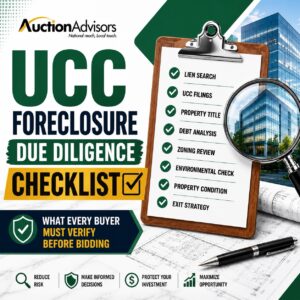
Start With Property-Level Due Diligence
Although the transaction involves an LLC, the underlying real estate remains a critical part of the investment.
Buyers should carefully evaluate:
- Current market value
- Property condition
- Deferred maintenance
- Environmental concerns
- Occupancy levels
- Lease agreements
- Local zoning compliance
- Title reports
- Existing liens
A comprehensive property review provides valuable insight into both immediate costs and long-term investment potential.
Review the Financial Health of the LLC
Since the LLC becomes part of the acquisition, understanding its financial condition is equally important.
Experienced investors typically review:
- Financial statements
- Tax returns
- Outstanding loans
- Accounts payable
- Existing contracts
- Cash flow history
- Operating expenses
- Pending financial obligations
These documents help identify risks that could affect the property’s future performance after closing.
Verify Legal Compliance
Legal due diligence is another essential component of every UCC foreclosure investment.
Buyers should confirm that the lender has properly followed applicable Article 9 requirements, including conducting a commercially reasonable sale and providing required notices.
Because every transaction is unique, working with qualified legal professionals can help investors better understand the sale structure and identify potential issues before bidding.
Build the Right Team Before You Bid
Successful investors rarely evaluate UCC foreclosures alone.
A strong advisory team may include:
- Commercial real estate attorneys
- UCC legal counsel
- Title professionals
- Accountants
- Environmental consultants
- Property inspectors
- Financial advisors
Each professional contributes specialized knowledge that helps reduce risk and supports informed decision-making.
Careful Preparation Leads to Better Investment Decisions
UCC foreclosures can offer attractive opportunities, but they reward preparation, not assumptions.
The most successful investors understand that purchasing an LLC requires careful analysis of both the company’s legal structure and the underlying real estate.
By conducting comprehensive due diligence before bidding, buyers place themselves in a stronger position to evaluate opportunities confidently, manage risk effectively, and pursue long-term investment success.
Conclusion
A UCC real estate foreclosure is not simply another type of foreclosure sale, it is a unique transaction that combines elements of commercial real estate, secured lending, and business ownership. Unlike a traditional foreclosure, buyers acquire ownership interests in an LLC rather than taking direct title to the property. This distinction makes due diligence more comprehensive and requires investors to evaluate both the underlying asset and the legal entity that owns it.
For investors willing to conduct thorough research and work with experienced professionals, UCC foreclosures can present valuable opportunities in the commercial real estate market. However, success depends on understanding existing liabilities, reviewing financial and legal documents, analyzing ownership rights, and confirming that the sale complies with Article 9 requirements.
Before participating in any UCC foreclosure sale, take the time to understand exactly what is being purchased, identify potential risks, and build a team of qualified legal and financial advisors. A well-informed approach can help you make confident investment decisions while avoiding costly surprises.
If you’re looking to learn more about UCC foreclosure sales, distressed asset auctions, or commercial real estate investment opportunities, AuctionAdvisors provides educational resources and professional services designed to help buyers navigate these complex transactions.
Frequently Asked Questions (FAQ)
1. What is a UCC real estate foreclosure?
A UCC real estate foreclosure is a sale conducted under Article 9 of the Uniform Commercial Code, where a lender forecloses on ownership interests in an LLC rather than directly on the real estate. The buyer acquires the entity that owns the property instead of receiving a deed to the property itself.
2. How is a UCC foreclosure different from a traditional foreclosure?
In a traditional foreclosure, ownership of the real estate transfers through a foreclosure process. In a UCC foreclosure, the transaction involves purchasing ownership interests in the business entity that holds title to the property. This means buyers often inherit the entity’s existing rights, obligations, and liabilities.
3. Why do lenders choose UCC foreclosures?
Lenders often use UCC foreclosures because they can be faster, more flexible, and less expensive than many traditional judicial foreclosure proceedings. Since the sale is conducted under Article 9 of the Uniform Commercial Code, it can allow lenders to recover collateral more efficiently while still meeting legal requirements for a commercially reasonable sale.
4. What should investors review before bidding on a UCC foreclosure?
Investors should perform comprehensive due diligence, including:
- Property inspections
- Title and lien searches
- Financial statements
- LLC operating agreements
- Tax records
- Existing loan obligations
- Pending litigation
- UCC filings
- Legal compliance reviews
Working with experienced legal and financial professionals can help identify risks before completing a purchase.
5. Are UCC foreclosures suitable for first-time investors?
They can be, but only with proper preparation. Because buyers are acquiring an existing legal entity rather than just real estate, first-time investors should seek guidance from experienced advisors, perform detailed due diligence, and fully understand the transaction before participating in a sale.