UCC Article 9 Guide
Can a UCC Article 9 Sale Be Unwound? Good-Faith Buyer Protections Under §9-617
A challenge to a UCC foreclosure sale does not necessarily mean the buyer must give the collateral back. Once a secured-party disposition has closed, UCC §9-617 can give a good-faith transferee powerful protection even if the secured party failed to comply with another Article 9 requirement. That distinction matters to lenders, debtors, bidders, and counsel because the remedy may shift from stopping the sale to seeking damages after the transfer has occurred.
Consider a bidder that wins a public sale, pays the purchase price, and closes while the debtor is disputing the adequacy of notice or the sale process. If the buyer acted at arm’s length and in good faith, a later finding that the secured party made a procedural mistake does not automatically restore ownership to the debtor. In a completed transaction, the central questions become what §9-617 protects, whether the transferee qualifies for that protection, and which remedies remain available. For broader background on how a secured-party disposition is prepared and conducted, see the UCC foreclosure sale process.
Usually, a completed UCC Article 9 sale is much harder to undo than it is to stop before closing. Section 9-617(b) provides that a good-faith transferee takes free of the debtor’s rights, the foreclosing security interest, and subordinate security interests or liens even when the secured party failed to comply with Article 9 or a judicial requirement. A party seeking to preserve the collateral itself generally has a stronger remedy before the disposition is complete, while post-sale disputes often focus on damages and other monetary consequences. State law and case law can affect the analysis.
What UCC §9-617 Actually Does After a Disposition
The starting point is the statutory text. Under UCC §9-617, a secured party’s disposition after default transfers to a transferee for value all of the debtor’s rights in the collateral, discharges the security interest under which the sale was made, and discharges subordinate security interests and subordinate liens. The statute then adds a separate protection for a transferee that acts in good faith.
Section 9-617(b) says that a good-faith transferee takes free of the rights and interests described above even if the secured party did not comply with Article 9 or with the requirements of a judicial proceeding. This rule is one reason the buyer’s status cannot be treated as an afterthought. Article 9 separates the validity and consequences of the transfer from the secured party’s potential liability for the way it conducted the sale.
What happens to the collateral
Section 9-617 addresses what rights the transferee receives and which debtor, foreclosing-lien, and subordinate-lien interests are cut off by the disposition.
What happens if the secured party violated Article 9
That is primarily a remedies issue. Injunctive relief before a sale and damages after noncompliance are addressed in UCC §9-625, subject to the applicable state’s enactment and case law.
This separation also explains why a procedural defect does not automatically translate into rescission of a completed sale. A notice problem, a disputed marketing process, or an allegation that the disposition was not commercially reasonable may still create serious exposure. For a broader discussion of those risks, see common legal challenges in UCC foreclosure auctions. But the remedy available against the secured party is not necessarily the same as the remedy available against the buyer.
Can a Completed UCC Article 9 Sale Be Unwound?
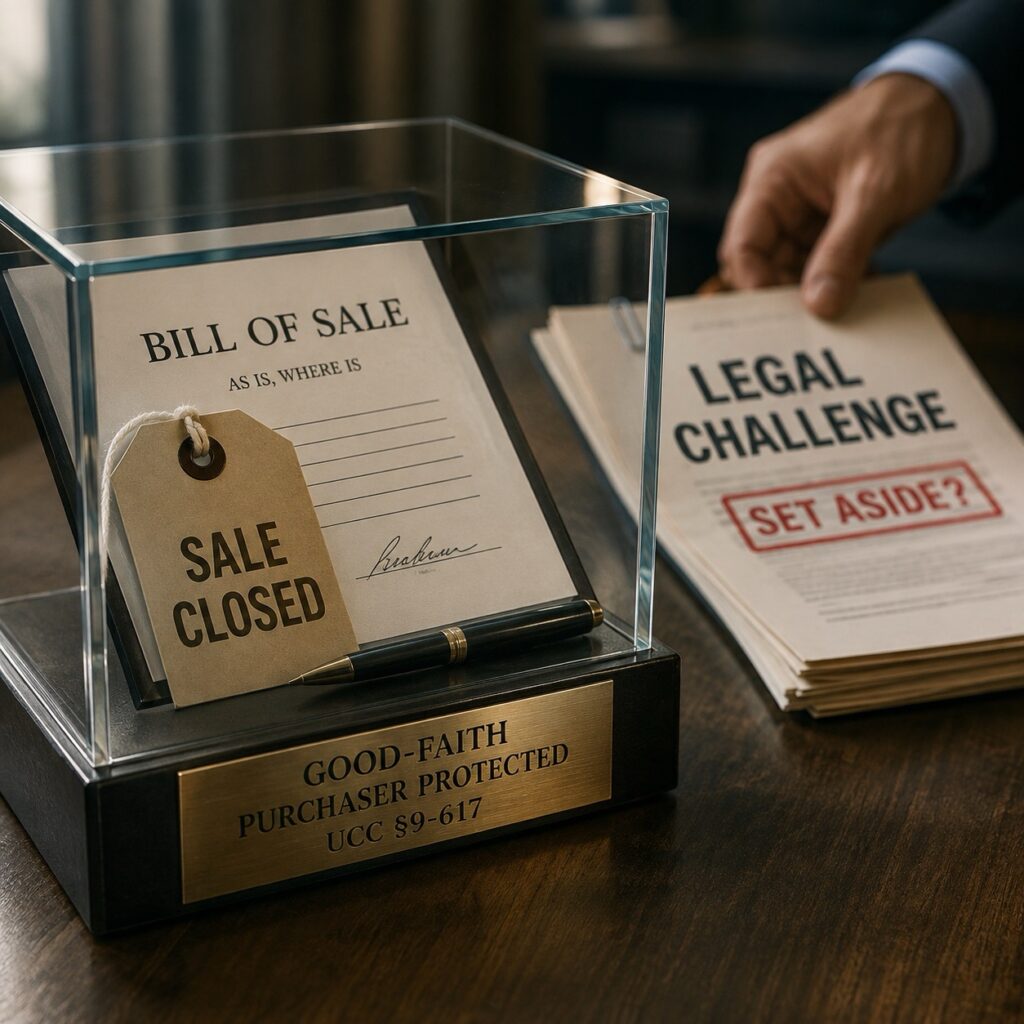
The safest general answer is that a completed sale to a good-faith transferee has substantial finality under §9-617. A party trying to recover the collateral itself faces a different problem after closing than before closing because the statute protects the transferee’s acquired rights even when the secured party has failed to comply with Article 9.
That does not justify saying that no UCC sale can ever be unwound under any circumstances. Article 9 is enacted state by state, judicial remedies can vary, and facts outside the ordinary §9-617 framework may matter. Questions can also arise over whether a disposition actually occurred, whether the purported buyer gave value, whether the buyer acted in good faith, whether the collateral description covered the asset transferred, or whether bankruptcy or other law changes the analysis.
A good-faith buyer protection rule is not a blanket statement that every Article 9 sale transfers every asset free and clear of every claim. The collateral sold, lien priority, the secured party’s rights in the asset, the governing transaction documents, and applicable non-UCC law still require careful review.
Timing is particularly important. Section 9-625(a) permits a court to restrain a secured party that “is not proceeding in accordance” with Article 9. That language supports the practical distinction between a party seeking to stop a threatened disposition and a party seeking to reverse a transfer that has already occurred. A debtor or other affected party that wants to preserve the property itself should have counsel evaluate available pre-sale relief promptly rather than assume the same remedy will remain available after closing.
Why Good-Faith Buyer Status Matters Under §9-617
Article 9 uses the term “good-faith transferee.” The general UCC definition of good faith in UCC §1-201 combines honesty in fact with observance of reasonable commercial standards of fair dealing. Whether that standard is satisfied can be fact-specific, and the applicable state’s version of the UCC should be reviewed.
For a third-party bidder, good faith is not simply a box checked because it paid money at an auction. Counsel may examine the buyer’s relationship with the secured party, what the buyer knew about the process, whether there were undisclosed side arrangements, how the bidding was conducted, and whether the buyer participated in conduct alleged to be unfair. Separate from buyer good faith, the secured party’s disposition must still satisfy the commercial reasonableness requirements applicable to the sale process.
A useful related distinction appears in Auction Advisors’ discussion of good faith and market-facing sale conduct. For the present issue, however, the narrower question is the transferee’s protection after disposition, not whether “good faith” alone makes the entire foreclosure process compliant.
Imagine a second scenario in which the successful bidder is affiliated with the secured party and allegedly received special access to information or a side agreement unavailable to other bidders. The debtor argues that the buyer was not acting in good faith. Under §9-617(c), a transferee that does not receive the subsection (b) protection can take subject to the debtor’s rights and the specified security interests or liens. That increases title risk for the buyer, but it still does not answer by itself what judicial remedy is available. The answer can depend on the jurisdiction and the procedural posture of the case.
What §9-617 Protects, and What It Does Not Automatically Eliminate
One common buyer mistake is to hear “free and clear” and assume every lien disappears. Section 9-617 is more specific. It describes the debtor’s rights in the collateral, the foreclosing security interest, and subordinate security interests or subordinate liens. A senior lien is not listed among the interests automatically discharged by §9-617(a).
| Right or Interest | General §9-617 Effect | Practical Buyer Question |
|---|---|---|
| Debtor’s rights in collateral | Transferred to a transferee for value through the disposition. | Did the debtor actually own the rights the secured party purported to sell? |
| Foreclosing security interest | Discharged by the disposition. | Was this the security interest under which the sale was conducted? |
| Subordinate security interests and liens | Discharged under §9-617(a), subject to the statute’s transferee rules. | Were the identified liens truly subordinate to the foreclosing interest? |
| Senior security interests and liens | Not automatically discharged by the text of §9-617(a). | What remains ahead of the foreclosing lien after the transfer? |
| Rights where transferee lacks good faith | Section 9-617(c) can leave the transferee subject to specified debtor rights and interests. | What does applicable state law permit the affected party to do with those surviving rights? |
This is why buyer diligence should not stop at the sale notice. A bidder may need to review UCC searches, the security agreement, amendments, intercreditor arrangements, the collateral schedule, lien priority, and the proposed transfer documents. The firm’s UCC foreclosure due diligence checklist for buyers addresses that broader diligence process.
If the Sale Cannot Be Reversed, What Remedies May Remain?
Section 9-617 protects transfer consequences; it does not erase a secured party’s potential liability. UCC §9-625(b) provides for damages for loss caused by a failure to comply with Article 9. Depending on the facts and governing law, noncompliance can also affect a deficiency claim, create disputes over surplus proceeds, or support other remedies that do not require returning the collateral to the debtor.
Redemption is another timing-sensitive right. UCC §9-623 allows specified parties to redeem collateral, but the statutory right ends at defined events that include the secured party’s disposition or contract for disposition. That makes the period before closing materially different from the period after the sale has been completed.
For lenders and counsel, this is also why strong process documentation matters even when a buyer appears protected. Records of notices, bidder outreach, data-room access, auction procedures, bids, communications, and closing steps can be important if the secured party later must defend its conduct. For related planning considerations, see risk management when conducting an Article 9 sale.
How Buyers, Secured Parties, and Counsel Can Reduce Post-Sale Uncertainty
No checklist can guarantee that a transaction will withstand a later challenge. Still, parties can reduce avoidable uncertainty by treating buyer status, collateral scope, lien priority, and sale process as connected diligence issues rather than separate closing tasks.
- Confirm exactly what is being sold. Match the sale notice, security agreement, collateral description, schedules, and transfer documents. A foreclosure cannot transfer more debtor rights than the disposition reaches.
- Review lien priority rather than assuming all liens are removed. Determine which interests are foreclosing, subordinate, or senior, and have counsel assess how the applicable state’s Article 9 rules apply.
- Protect an arm’s-length record. Buyers should preserve evidence of bidding, communications, access to information, payment, and closing. If affiliations or special arrangements exist, those issues should be addressed before the sale rather than discovered in litigation.
- Document the market process. The secured party’s counsel evaluates legal compliance. An auction professional may assist with marketing, bidder outreach, data-room coordination, bid administration, sale logistics, and records of market exposure.
- Identify objections before closing. If a debtor, junior lienholder, guarantor, or bidder raises a serious issue, counsel should evaluate it while prospective remedies may still include injunctive relief or redemption.
Commercial reasonableness remains a separate requirement from the buyer’s good-faith protection. Article 9 examines the method, manner, time, place, and other terms of the disposition rather than any single factor such as price or number of bidders. The deeper framework is discussed in what makes an Article 9 disposition commercially reasonable.
What the New York Atlas Decision Says About Unwinding a Closed Sale
A leading example is Atlas MF Mezzanine Borrower, LLC v. Macquarie Texas Loan Holder LLC, decided by New York’s Appellate Division, First Department in 2019. The debtor sought to invalidate and unwind a completed nonjudicial UCC sale. The court rejected that remedy and distinguished between the transferee-rights provisions in §9-617 and the remedies for noncompliance in §9-625.
The court reasoned that §9-617 does not itself authorize a court to unwind a concluded UCC sale. It also treated §9-625(a) injunctive relief as prospective, while identifying damages under §9-625(b) as the post-disposition remedy for Article 9 noncompliance in the circumstances before it. Notably, the court concluded that the sale could not be unwound even if the transferee were ultimately found to have acted in bad faith.
That final point should not be generalized into a nationwide rule without qualification. Atlas is New York authority, and Article 9 is enacted by individual states. Courts elsewhere may confront different statutory language, facts, equitable theories, bankruptcy issues, or procedural questions. The applicable state’s version of Article 9 and relevant case law should be reviewed by counsel.
The practical lesson is more durable: if preserving the collateral is the objective, timing matters. Once a disposition has closed, the buyer’s §9-617 position and the jurisdiction’s remedial law can sharply narrow the path to recovering the asset itself. That makes careful pre-sale coordination, transparent bidder access, sound documentation, and prompt legal review more valuable than relying on a post-closing challenge.
Frequently Asked Questions
Does UCC §9-617 make every Article 9 sale final?
No. Section 9-617 gives strong transfer protections, especially to a good-faith transferee, but it is not a universal immunity provision. The outcome can depend on whether a disposition was actually completed, whether the transferee gave value and acted in good faith, what collateral was covered, lien priority, the applicable state’s enactment, and relevant case law. Other law, including bankruptcy law, may also affect a particular transaction.
What is a good-faith transferee under UCC Article 9?
Article 9 uses “good-faith transferee” in §9-617. The UCC’s general definition of good faith combines honesty in fact with observance of reasonable commercial standards of fair dealing. Whether a buyer satisfies that standard is fact-specific. Relationships with the lender, undisclosed arrangements, knowledge of alleged irregularities, and participation in the sale process can become relevant, depending on the governing law and the facts.
Can a debtor stop a UCC Article 9 sale before it closes?
Potentially. UCC §9-625(a) authorizes a court to order or restrain collection, enforcement, or disposition when a secured party is not proceeding in accordance with Article 9. Whether injunctive relief is available depends on the jurisdiction, procedural requirements, facts, and the standards for equitable relief. A party considering pre-sale relief should have qualified counsel evaluate the situation promptly because available remedies can change after disposition.
What happens if the secured party violated Article 9 but the buyer acted in good faith?
Section 9-617(b) specifically addresses that situation. A good-faith transferee can take free of the debtor’s rights, the foreclosing security interest, and subordinate security interests or liens even if the secured party failed to comply with Article 9 or a judicial requirement. The secured party may still face damages or other consequences for noncompliance. Buyer protection and secured-party liability are separate questions.
Can a bad-faith buyer lose the protection of §9-617?
Yes. Section 9-617(c) provides that a transferee that does not take free under subsection (b) takes subject to specified debtor rights and security interests or liens. The harder question is what remedy follows from that status. In New York, the Atlas decision held that a concluded sale could not be unwound even if the transferee were found to have acted in bad faith. Other jurisdictions should be researched separately.
Does a UCC foreclosure sale eliminate senior liens?
Not automatically under §9-617(a). That subsection provides for discharge of the foreclosing security interest and subordinate security interests or subordinate liens. It does not say that senior liens are discharged merely because the collateral was sold. Buyers should have counsel review UCC searches, priority, intercreditor arrangements, and other applicable law rather than assume an Article 9 sale always delivers an asset free of every lien.
Can a debtor still recover damages after an Article 9 sale closes?
Potentially. UCC §9-625(b) provides for damages for loss caused by a person’s failure to comply with Article 9. The availability and measure of damages depend on the claimant, the violation, causation, the transaction type, and governing law. Other consequences may include disputes over a deficiency or surplus. A damages claim is distinct from a claim seeking return of the collateral itself.
When does the right to redeem collateral end under Article 9?
UCC §9-623 allows specified parties to redeem collateral by satisfying the obligations and reasonable expenses described in the statute, but the right ends at defined events. Those include when the secured party has collected the collateral, disposed of it or contracted for its disposition under §9-610, or accepted it in satisfaction of the obligation under §9-622. State enactments and transaction facts should be reviewed.
Does commercial unreasonableness automatically invalidate a completed UCC sale?
Not automatically. Commercial reasonableness concerns how the secured party conducted the disposition, including its method, manner, time, place, and other terms. A violation can create remedies and affect deficiency disputes, but the buyer’s rights after transfer are separately addressed by §9-617. Whether a court can set aside a completed transaction is a jurisdiction-specific remedial question, not an automatic consequence of one alleged process defect.
What should a buyer review before bidding at a UCC foreclosure sale?
A buyer should focus on what collateral is actually being sold, the debtor’s rights in it, the foreclosing lien, potential senior liens, the sale terms, available diligence materials, transfer restrictions, and the proposed closing documents. Buyers should also preserve an arm’s-length record that supports good-faith status. Legal counsel can analyze title, priority, statutory issues, and transaction documents; auction professionals can support the marketing and bidding process.
For assistance with the auction and marketing components of a secured-party sale, contact Auction Advisors.
Educational note: This article provides general information about UCC Article 9 and is not legal advice. Counsel should evaluate the applicable state’s statute, case law, transaction documents, collateral, and facts.
Sources: UCC §9-617, Cornell Legal Information Institute | UCC §1-201, Cornell Legal Information Institute | UCC §9-625, Cornell Legal Information Institute | UCC §9-623, Cornell Legal Information Institute | Atlas MF Mezzanine Borrower, LLC v. Macquarie Texas Loan Holder LLC, New York Courts