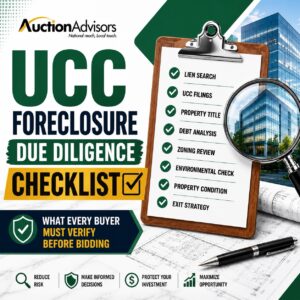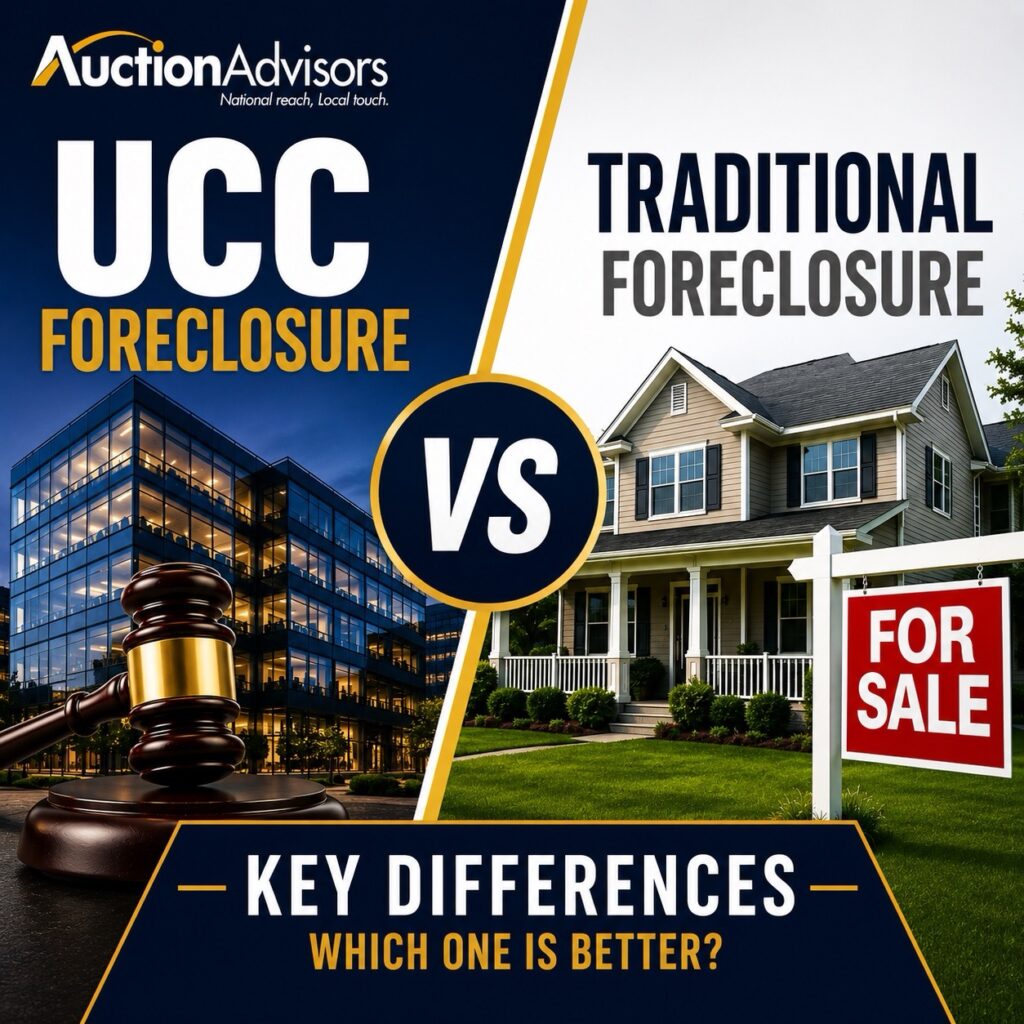
Foreclosure opportunities have long attracted real estate investors looking to purchase commercial and residential properties below market value. However, not every foreclosure follows the same legal process. While most investors are familiar with traditional foreclosure sales, UCC foreclosures represent a different type of transaction that requires a broader understanding of business ownership, secured lending, and due diligence.
Although both processes occur after a borrower defaults on a loan, the similarities often end there. A traditional foreclosure transfers ownership of the real estate itself, whereas a UCC foreclosure typically transfers ownership interests in the legal entity, usually a limited liability company (LLC) that owns the property. This distinction changes how investors evaluate risk, conduct due diligence, and plan for long-term ownership.
Understanding these differences is essential before participating in any foreclosure sale. Whether you’re purchasing your first commercial investment or expanding an existing portfolio, knowing how each foreclosure process works can help you make more informed decisions and avoid costly surprises.
In this guide, we’ll compare UCC foreclosures and traditional foreclosures, explain their key differences, and highlight the factors every investor should consider before bidding. To learn more about commercial auctions and distressed asset sales, visit AuctionAdvisors.
Understanding the Main Differences Between UCC and Traditional Foreclosures
Although both foreclosure types are triggered by a borrower’s default, they follow different legal procedures and result in different ownership transfers.
Understanding these differences helps investors determine which investment opportunity best aligns with their financial goals and risk tolerance.
What Is a Traditional Foreclosure?
A traditional foreclosure occurs when a borrower fails to meet the terms of a mortgage loan secured directly by real estate.
Depending on state law, the lender may initiate either a judicial or non-judicial foreclosure process. Once completed, ownership of the property transfers to the highest bidder or the lender if no qualified bids are received.
Traditional foreclosure sales typically involve:
- Real estate mortgages
- Court supervision in many states
- Public foreclosure auctions
- Property deed transfers
- Title ownership changes
Because the transaction focuses on the property itself, buyers generally receive ownership through a deed after satisfying applicable legal requirements.
This process has been the standard method of recovering real estate collateral for decades.
What Is a UCC Foreclosure?
A UCC foreclosure follows a different legal framework.
Instead of foreclosing directly on the real estate, the lender enforces its security interest against ownership interests in a business entity, most commonly an LLC that owns the property.
After default, the lender conducts a sale under Article 9 of the Uniform Commercial Code (UCC), transferring ownership of the LLC rather than transferring title to the underlying real estate.
The property remains owned by the LLC both before and after the transaction.
Only the ownership of the company changes.
This structure is common in commercial real estate financing because it provides lenders with an efficient method of enforcing security interests while allowing ownership entities to remain intact.
Comparing the Legal Process
One of the most noticeable differences between these foreclosure methods is how the sale is conducted.
Traditional Foreclosure
Traditional foreclosure generally includes:
- Court proceedings (where applicable)
- Formal foreclosure filings
- Judicial oversight
- Public notices
- Sheriff’s sales or trustee sales
- Transfer of property title
Depending on state law, the process may take several months or even years to complete.
UCC Foreclosure
By comparison, UCC foreclosure sales generally occur outside the courtroom.
The lender must conduct a commercially reasonable sale, provide notice to required parties, and comply with Article 9 requirements before selling the pledged ownership interests.
Because fewer court proceedings are involved, UCC foreclosures are often completed much faster than traditional foreclosure actions.
This efficiency benefits lenders but also places greater responsibility on buyers to complete independent due diligence before participating in the sale.
For investors interested in current opportunities, AuctionAdvisors provides information on active UCC foreclosure sales.
Which Process Is Faster?
Speed is one of the primary reasons lenders frequently choose UCC foreclosure procedures.
Traditional Foreclosure Timeline
The traditional foreclosure process may include:
- Loan default
- Legal filings
- Court hearings
- Notice periods
- Auction scheduling
- Title transfer
Each stage adds additional time before ownership changes hands.
UCC Foreclosure Timeline
A UCC foreclosure often proceeds more efficiently because:
- Court involvement is limited
- Article 9 provides a streamlined legal framework
- Ownership interests, not real estate, are sold
- Private sales may be conducted when permitted
While every transaction is unique, many UCC sales can be completed significantly faster than comparable judicial foreclosure proceedings.
For investors, this means opportunities may appear and close more quickly, making preparation and due diligence especially important.
Why Investors Should Understand Both Processes
Both foreclosure methods offer investment opportunities, but they appeal to different types of buyers.
Traditional foreclosures are often more familiar to residential investors and individuals purchasing individual properties.
UCC foreclosures are more commonly associated with commercial real estate transactions involving sophisticated ownership structures, institutional lenders, and LLC-owned assets.
Understanding the legal differences between these two approaches allows investors to:
- Evaluate opportunities more accurately
- Understand ownership responsibilities
- Identify potential liabilities
- Develop stronger due diligence strategies
- Make more informed bidding decisions
No matter which foreclosure type you pursue, knowledge remains one of the most valuable investment tools.
Comparing Ownership, Liabilities, and Buyer Responsibilities
One of the most significant differences between a UCC foreclosure and a traditional foreclosure is what the buyer actually acquires after the sale. While both transactions may involve valuable commercial real estate, the legal ownership structure is very different. Understanding these differences helps investors evaluate potential risks, estimate future costs, and make informed investment decisions.
Many first-time investors focus on the property’s location, condition, or purchase price. However, experienced buyers know that ownership rights and ongoing responsibilities can have an even greater impact on the success of an investment.
What Does the Buyer Acquire in a Traditional Foreclosure?
In a traditional foreclosure, the successful bidder typically purchases the real estate itself.
Once the foreclosure process is complete and the transaction closes, ownership transfers through a deed recorded in the appropriate jurisdiction.
Generally, buyers receive:
- Legal title to the property
- Ownership rights associated with the real estate
- Control over future property management
- Authority to lease, renovate, refinance, or sell the property (subject to applicable laws and restrictions)
Although certain liens or obligations may remain depending on the foreclosure process and state law, buyers usually acquire direct ownership of the property rather than ownership of a business entity.
This structure is familiar to many investors because it resembles a conventional real estate purchase.
What Does the Buyer Acquire in a UCC Foreclosure?
A UCC foreclosure works differently.
Instead of purchasing the property directly, buyers usually acquire ownership interests in the LLC that owns the real estate.
The LLC remains the legal owner of the property before and after the sale.
Only the ownership of the company changes.
As a result, buyers may receive:
- Ownership of the LLC
- Membership interests
- Rights defined by the operating agreement
- Existing business relationships
- Control of the entity’s assets (if acquiring a controlling interest)
This distinction is one of the most important concepts every investor should understand before participating in a UCC foreclosure sale.
Existing Liabilities Continue With the LLC
Another important difference involves financial and legal obligations.
In many traditional foreclosure transactions, certain junior liens may be eliminated according to applicable foreclosure laws.
With a UCC foreclosure, however, the buyer generally acquires the LLC together with its existing obligations because ownership of the entity, not the real estate, is transferred.
Potential liabilities may include:
- Existing commercial mortgages
- Property tax obligations
- Vendor contracts
- Pending litigation
- Regulatory compliance issues
- Insurance obligations
- Service agreements
- Outstanding business debts
Understanding these liabilities before bidding is essential because they may influence both short-term expenses and long-term investment returns.
Ownership Rights Depend on the Membership Interest Being Sold
Not every UCC foreclosure transfers complete ownership.
Some sales involve:
- 100% membership interests
- Majority ownership
- Minority ownership
- Partial economic interests
The percentage being sold directly affects the buyer’s authority after closing.
For example, a buyer acquiring only a minority ownership interest may have limited influence over:
- Property refinancing
- Asset sales
- Capital improvements
- Leasing decisions
- Company management
- Major financial decisions
The LLC operating agreement often determines these rights, making it one of the most important documents during due diligence.
Buyer Responsibilities Extend Beyond Property Ownership
Traditional foreclosure buyers generally concentrate on managing the real estate itself.
UCC foreclosure buyers often assume additional business responsibilities because they now own the company holding title to the property.
These responsibilities may include:
- Maintaining corporate records
- Filing annual reports
- Managing business finances
- Complying with tax requirements
- Supervising property operations
- Maintaining insurance coverage
- Managing existing contracts
This broader scope of responsibility is one reason UCC foreclosure investments often appeal to experienced commercial real estate investors.
Why Ownership Structure Matters for Future Investment Decisions
The ownership structure influences far more than the initial acquisition.
It can affect future decisions involving:
- Refinancing
- Property sales
- Additional financing
- Investor partnerships
- Tax planning
- Estate planning
- Business succession
Understanding these long-term implications before purchasing allows investors to develop more effective investment strategies and avoid unexpected operational challenges.
For investors seeking additional educational resources about UCC foreclosure transactions and distressed commercial assets, AuctionAdvisors regularly publishes industry insights through its educational blog.
Understanding Ownership Helps Investors Reduce Risk
Whether purchasing through a traditional foreclosure or a UCC foreclosure, understanding exactly what is being acquired should always be one of the first steps in the investment process.
Successful investors look beyond the purchase price to evaluate:
- Ownership rights
- Existing liabilities
- Business obligations
- Financial commitments
- Operational responsibilities
- Long-term investment flexibility
This broader perspective helps investors make more informed decisions and better prepares them for the responsibilities that follow closing.
Learning exactly what ownership includes before bidding can significantly reduce investment risk and improve the likelihood of achieving long-term financial success.
Pros and Cons of Each Foreclosure Method
Both UCC foreclosures and traditional foreclosures can provide valuable investment opportunities, but neither option is universally better than the other. Each foreclosure method has its own advantages, challenges, legal considerations, and risk profile.
Understanding these differences allows investors to select opportunities that align with their investment objectives, experience level, and risk tolerance. Rather than focusing solely on the purchase price, successful investors evaluate the entire transaction, from ownership structure and legal obligations to long-term operational responsibilities.
Let’s examine the advantages and disadvantages of each foreclosure method.
Advantages of a Traditional Foreclosure
Traditional foreclosures remain one of the most common methods of acquiring distressed real estate.
Because the process has existed for decades, many investors, lenders, and legal professionals are familiar with its procedures.
Some key advantages include:
Direct Property Ownership
One of the biggest benefits is that buyers receive ownership of the real estate itself through a deed.
This simplifies future decisions involving:
- Property management
- Leasing
- Renovations
- Refinancing
- Resale
For many investors, direct ownership provides greater clarity regarding rights and responsibilities.
Familiar Legal Process
Traditional foreclosure procedures are well established in most jurisdictions.
Although timelines vary by state, investors generally understand the process, including:
- Public notices
- Court proceedings (when applicable)
- Foreclosure auctions
- Title transfers
This familiarity can make the acquisition process feel more predictable for buyers with prior foreclosure experience.
Easier Financing Opportunities
Because buyers acquire the property directly, financing options are often more familiar to commercial lenders.
Many banks and financial institutions have established lending programs designed specifically for foreclosure acquisitions.
This can simplify financing compared to transactions involving ownership interests in business entities.
Disadvantages of a Traditional Foreclosure
Despite these advantages, traditional foreclosures also present several challenges.
Longer Timelines
Judicial foreclosure proceedings often involve:
- Court filings
- Legal hearings
- Notice requirements
- Waiting periods
- Appeals
These steps may significantly extend the acquisition timeline before ownership transfers.
Increased Legal Costs
Lengthy legal proceedings can increase expenses for lenders and occasionally affect buyers through delayed closings or additional administrative requirements.
Greater Competition
Traditional foreclosure auctions often attract a large number of investors because the process is widely understood.
Higher competition may reduce opportunities to purchase properties at substantial discounts.
Advantages of a UCC Foreclosure
UCC foreclosure sales have become increasingly popular in commercial real estate because they offer several benefits that differ from traditional foreclosure transactions.
Faster Transaction Process
One of the primary advantages of a UCC foreclosure is speed.
Because Article 9 allows lenders to foreclose on pledged ownership interests rather than pursuing lengthy judicial foreclosure proceedings, transactions can often move much more quickly.
This benefits both lenders and investors by reducing delays and allowing assets to return to productive use sooner.
Flexible Sale Structure
Unlike many court-supervised foreclosure sales, UCC foreclosures provide lenders with greater flexibility regarding:
- Sale timing
- Marketing strategies
- Auction procedures
- Private sale opportunities (where permitted)
This flexibility may create attractive acquisition opportunities for qualified investors. To learn more about current UCC foreclosure opportunities.
Access to Unique Commercial Investments
Many high-value commercial properties, including office buildings, hotels, shopping centers, multifamily developments, and industrial facilities, are owned through LLC structures.
As a result, UCC foreclosure sales often provide access to investment opportunities that may not appear through traditional foreclosure auctions.
Experienced commercial investors frequently monitor these transactions because they can involve complex assets with significant long-term value.
Disadvantages of a UCC Foreclosure
Although UCC foreclosures offer several advantages, they also require investors to assume greater responsibility during the acquisition process.
More Complex Due Diligence
Unlike a traditional foreclosure, buyers must evaluate:
- The real estate
- The LLC
- Financial records
- Operating agreements
- Existing contracts
- Tax filings
- Pending litigation
- Corporate governance
This additional layer of investigation requires more time and specialized expertise.
Existing Liabilities May Continue
Because buyers acquire ownership of the business entity rather than the real estate directly, existing obligations often remain with the LLC.
These may include:
- Mortgages
- Tax liabilities
- Vendor obligations
- Regulatory issues
- Service contracts
- Pending legal matters
Understanding these obligations before bidding is essential to accurately evaluating the investment.
Ownership Rights May Be Limited
Not every UCC foreclosure transfers full ownership.
Some transactions involve minority membership interests that provide limited authority over important business decisions.
Investors should carefully review:
- Ownership percentage
- Voting rights
- Management authority
- Transfer restrictions
- Buy-sell provisions
These factors directly influence the buyer’s ability to manage the investment after closing.
Which Foreclosure Method Fits Your Investment Strategy?
The right choice depends on your investment goals, experience, and willingness to perform detailed due diligence.
A traditional foreclosure may be better suited for investors who prefer:
- Direct property ownership
- Familiar legal procedures
- Straightforward financing
- Simpler acquisitions
A UCC foreclosure may appeal to investors seeking:
- Commercial real estate opportunities
- Faster acquisition timelines
- Complex investment structures
- Value-added opportunities
- Sophisticated transactions
Neither approach guarantees success.
Instead, successful investors focus on understanding the risks, evaluating the available information, and making decisions based on careful analysis rather than assumptions. For more educational resources covering commercial real estate, distressed assets, and UCC foreclosure transactions.
Which Type of Foreclosure Is Right for Your Investment Goals?
Choosing between a UCC foreclosure and a traditional foreclosure depends on your investment objectives, experience level, and willingness to perform detailed due diligence. Neither approach is inherently better; they simply serve different purposes and appeal to different types of investors.
For example, a first-time investor purchasing a small commercial property may prefer the familiarity of a traditional foreclosure process. An experienced commercial investor, on the other hand, may seek out UCC foreclosure opportunities because they can provide access to complex assets, faster transactions, and unique investment structures.
Before participating in either type of sale, consider asking yourself the following questions:
- Do I understand what I’m actually purchasing?
- Have I reviewed all legal and financial documents?
- Am I prepared to inherit an existing LLC if applicable?
- Have I identified existing liens or outstanding debt?
- Have I consulted qualified legal and financial professionals?
- Does this opportunity fit my long-term investment strategy?
Answering these questions honestly can help you make better-informed investment decisions while reducing unnecessary risk.
Successful investors don’t simply chase discounted purchase prices; they evaluate the complete investment opportunity.
Continue Expanding Your Knowledge
The commercial real estate market continues to evolve, and so do foreclosure strategies. Staying informed about legal developments, auction trends, and due diligence best practices allows investors to recognize opportunities while minimizing potential risks.
Whether you’re exploring your first UCC foreclosure or managing an established investment portfolio, continuing your education is one of the best investments you can make.
AuctionAdvisors regularly publishes educational resources that help investors better understand Article 9 sales, commercial auctions, distressed assets, and market trends.
For additional insights, read:
Digital Engagement Metrics in UCC Article 9 Sales: An Evidentiary Tool for Practitioners
Conclusion
Both UCC foreclosures and traditional foreclosures offer valuable opportunities for commercial real estate investors, but understanding the differences between them is essential before making a purchase.
Traditional foreclosures generally provide direct ownership of the property through a well-established legal process that many investors already understand. UCC foreclosures, by contrast, involve acquiring ownership interests in the entity that owns the property, creating additional considerations related to business operations, existing liabilities, financial obligations, and legal due diligence.
While UCC foreclosure transactions can often move faster and provide access to unique commercial investment opportunities, they also require investors to conduct a broader investigation before bidding. Reviewing operating agreements, financial statements, tax records, existing debt, contracts, and ownership rights helps reduce uncertainty and supports more informed decision-making.
Ultimately, the best investment is not determined by the foreclosure type alone it depends on how thoroughly you evaluate the opportunity before committing capital.
Whether you’re considering your first foreclosure purchase or expanding an experienced commercial real estate portfolio, understanding these legal structures can help you protect your investment and pursue long-term success.
Frequently Asked Questions (FAQ)
1. What is the main difference between a UCC foreclosure and a traditional foreclosure?
A traditional foreclosure transfers ownership of the real estate through a deed, while a UCC foreclosure generally transfers ownership interests in the LLC or business entity that owns the property. Buyers in a UCC foreclosure acquire the entity rather than the property directly.
2. Which foreclosure process is usually faster?
UCC foreclosures are often completed more quickly because they are conducted under Article 9 of the Uniform Commercial Code and generally involve less court oversight than many traditional judicial foreclosures.
3. Do existing mortgages remain after a UCC foreclosure?
In many cases, yes. Since the transaction usually transfers ownership of the LLC instead of the real estate itself, existing mortgages, tax liens, and other financial obligations may remain in place. Investors should carefully review the property’s debt structure before bidding.
4. Which type of foreclosure requires more due diligence?
A UCC foreclosure generally requires broader due diligence because investors must evaluate both the commercial property and the legal entity that owns it. This includes reviewing financial records, operating agreements, contracts, tax filings, and pending legal matters in addition to the property’s condition.
5. Are UCC foreclosures only used for commercial real estate?
While UCC foreclosures are most commonly associated with commercial real estate transactions involving LLC ownership structures, they may also be used in other secured lending situations where business ownership interests are pledged as collateral.
6. Where can investors learn more about UCC foreclosure opportunities?
Investors can find additional educational resources and current opportunities.