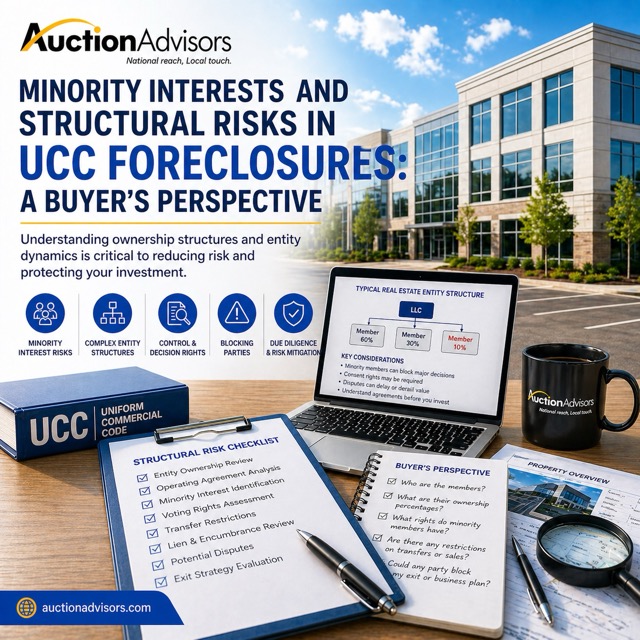
UCC real estate foreclosures introduce structural complexities that extend beyond traditional real estate acquisition risks. Among the most significant of these complexities is the possibility that the transaction involves the sale of less than 100% of the ownership interests in the entity holding the underlying asset. This scenario creates a distinct category of risk associated with minority ownership and limited control.
As outlined in the source material, not all UCC foreclosure sales result in the transfer of full ownership. In certain cases, the lender’s collateral may consist only of a partial interest in the entity, meaning that the buyer acquires a minority position rather than full control. This distinction is critical because it directly affects the buyer’s ability to influence decisions, manage the asset, and execute an investment strategy.
Understanding these structural risks is essential for evaluating UCC foreclosure opportunities. A transaction that appears financially attractive may present operational challenges if control is constrained. As a result, assessing ownership structure, governance rights, and operational limitations becomes a central component of the evaluation process.
1. Understanding Minority Interest in UCC Foreclosures
A minority interest in a UCC foreclosure transaction refers to the acquisition of less than a controlling stake in the entity that owns the real estate. This occurs when the lender’s security interest is limited to a portion of the membership interests, resulting in a sale that transfers only that portion to the buyer.
In such cases, the buyer does not gain unilateral authority over the entity or the underlying asset. Instead, ownership is shared with existing members, whose rights and roles remain intact following the transaction. This creates a structure where decision-making authority is distributed rather than centralized.
The implications of this arrangement extend beyond simple ownership percentages. The rights associated with a minority interest are often defined by the entity’s governing documents, which may limit the buyer’s ability to influence key decisions. These limitations can affect areas such as refinancing, leasing, capital improvements, and asset disposition.
As a result, understanding the nature of the interest being acquired is critical. The percentage of ownership alone does not determine control; the associated rights and restrictions play an equally important role in defining the buyer’s position within the entity.
2. Control Limitations and Decision-Making Constraints
One of the primary risks associated with minority ownership is the limitation on control over the entity’s operations and strategic direction. Unlike a majority owner, a minority interest holder may have limited or no authority to make unilateral decisions regarding the management of the asset.
Key Control Limitations:
- Inability to approve major transactions independently
- Limited influence over refinancing or sale decisions
- Restricted authority in operational management
- Dependence on approval from other members
Impact on Investment Strategy:
- Reduced ability to implement business plans
- Potential delays in decision-making processes
- Increased reliance on cooperation from other stakeholders
These constraints can significantly affect the buyer’s ability to manage the investment effectively. Even when the asset itself presents strong fundamentals, the lack of control may limit the ability to realize value.
The presence of control limitations highlights the importance of evaluating governance structures alongside financial considerations. Without a clear understanding of decision-making authority, the practical implications of ownership may differ significantly from initial expectations.
3. The Role of Operating Agreements in Defining Rights
The operating agreement governing the entity plays a central role in defining the rights, obligations, and limitations associated with ownership interests. In UCC foreclosure transactions involving minority interests, this document becomes particularly important.
Operating agreements typically outline how decisions are made, how profits are distributed, and what restrictions apply to ownership transfers. These provisions can significantly influence the value and flexibility of a minority interest.
For example, certain agreements may require unanimous consent for major decisions, while others may grant controlling authority to a designated manager or managing member. These structures can limit the ability of minority owners to influence outcomes, even in situations where their economic stake is substantial.
A detailed review of the operating agreement is therefore essential. Understanding how governance is structured and how rights are allocated provides insight into the practical implications of ownership. Without this analysis, the buyer may acquire an interest that offers limited ability to affect the performance or direction of the investment.
4. Transfer Restrictions and Ownership Limitations
Transfer restrictions are a common feature of operating agreements and can create additional challenges for buyers acquiring minority interests in UCC foreclosures. These restrictions govern how ownership interests can be transferred, sold, or assigned within the entity.
Common Transfer Restrictions:
- Limitations on selling or assigning membership interests
- Requirements for approval by other members
- Rights of first refusal held by existing owners
- Conditions tied to ownership changes
Implications for Buyers:
- Reduced liquidity of the investment
- Constraints on exit strategies
- Potential delays in transferring ownership
These restrictions can significantly affect the flexibility of the investment. A buyer may find that exiting the position or restructuring ownership is more complex than anticipated.
Understanding these provisions is critical for evaluating both the short-term and long-term implications of the transaction. Transfer restrictions not only affect ownership rights but also influence how value can be realized over time.
5. Governance Structures and Manager-Controlled Entities
In many UCC foreclosure transactions, the entity may be structured as a manager-managed LLC, where decision-making authority is centralized in a designated manager rather than distributed among members. This governance model can further limit the influence of minority interest holders.
Under a manager-controlled structure, the manager has authority over day-to-day operations and key strategic decisions. Minority members may have limited rights to intervene or influence these decisions, depending on the terms of the operating agreement.
This structure can create situations where the buyer holds an economic interest without corresponding operational control. While the investment may generate returns, the ability to direct its performance is constrained by the governance framework.
Evaluating governance structures is therefore a critical component of due diligence. Understanding who controls decision-making and how authority is exercised provides insight into how the investment will function in practice. This analysis ensures that the buyer fully understands the relationship between ownership and control within the entity.
6. Risk of Deadlock and Member Disputes
Minority ownership structures can increase the likelihood of disputes between members, particularly when decision-making authority is shared or requires consensus. These disputes may arise over strategic direction, financial decisions, or operational management.
Common Sources of Conflict:
- Disagreements over refinancing or asset disposition
- Conflicting investment objectives among members
- Disputes regarding capital contributions or distributions
- Interpretation of operating agreement provisions
Potential Consequences:
- Delays in executing business plans
- Increased legal and administrative costs
- Reduced efficiency in decision-making
- Risk of prolonged operational uncertainty
Deadlock situations can occur when members are unable to reach an agreement on key decisions. In such cases, the inability to move forward may affect the performance and value of the investment.
Understanding the potential for disputes and how they are addressed within the operating agreement is an important aspect of evaluating minority interest risk. This ensures that the buyer is prepared for the practical realities of shared ownership.
7. Economic Exposure Without Operational Control
A key risk associated with minority interests in UCC foreclosures is the possibility of economic exposure without corresponding operational control. This occurs when the buyer participates in the financial outcomes of the investment but lacks the authority to influence its management.
This imbalance can create challenges in situations where strategic decisions impact the performance of the asset. For example, decisions related to leasing, capital improvements, or refinancing may be made without input from minority owners, even though those decisions directly affect their investment.
This dynamic requires careful consideration of how returns are generated and distributed. Buyers must evaluate whether the expected financial benefits justify the limitations on control and influence.
The relationship between economic participation and operational authority is a defining feature of minority interest investments. Understanding this relationship is essential for assessing whether the structure aligns with the buyer’s objectives and risk tolerance.
8. Evaluating Minority Interest Opportunities in Practice
Evaluating minority interest opportunities in UCC foreclosures requires a structured approach that integrates ownership, governance, and financial analysis. Buyers must assess not only the percentage of ownership being acquired but also the rights and limitations associated with that interest.
Key Evaluation Considerations:
- Percentage of ownership and associated rights
- Governance structure and decision-making authority
- Transfer restrictions and exit options
- Alignment with existing members
Purpose of Evaluation:
- To understand the practical implications of ownership
- To assess the feasibility of achieving investment objectives
- To identify potential constraints and risks
By considering these factors collectively, buyers can form a comprehensive view of the opportunity. This approach ensures that decisions are based on a full understanding of both the benefits and limitations of minority ownership.
The evaluation process highlights the importance of aligning structural characteristics with investment goals, ensuring that the transaction supports the intended outcomes.
Conclusion
Minority interests and structural risks represent a critical aspect of UCC foreclosure transactions that must be carefully evaluated. Unlike traditional real estate acquisitions, where ownership and control are typically aligned, UCC foreclosures may separate economic participation from operational authority.
As emphasized in the source material, understanding the percentage interest being acquired and the rights associated with that interest is essential. This includes evaluating governance structures, operating agreements, and transfer restrictions that define how ownership functions in practice.
A comprehensive approach to analyzing these factors provides the foundation for informed decision-making. By understanding the structural dynamics of minority ownership, buyers can assess whether a given opportunity aligns with their objectives and risk profile.
FAQs
1. What is a minority interest in UCC foreclosure?
It is ownership of less than a controlling stake in the entity.
2. Does minority ownership provide control?
Not necessarily; control depends on governance structure.
3. Why are operating agreements important?
They define rights, restrictions, and decision-making authority.
4. What are transfer restrictions?
Limits on selling or transferring ownership interests.
5. Can minority owners influence decisions?
Often limited, depending on the agreement.
6. What is manager-controlled governance?
A structure where a manager controls operations.
7. What is deadlock risk?
Inability of members to agree on key decisions.
8. What is economic exposure risk?
Having financial stake without operational control.
9. Are minority interests risky?
They can be, depending on structure and rights.
10. What should buyers evaluate?
Ownership percentage, rights, governance, and restrictions.